
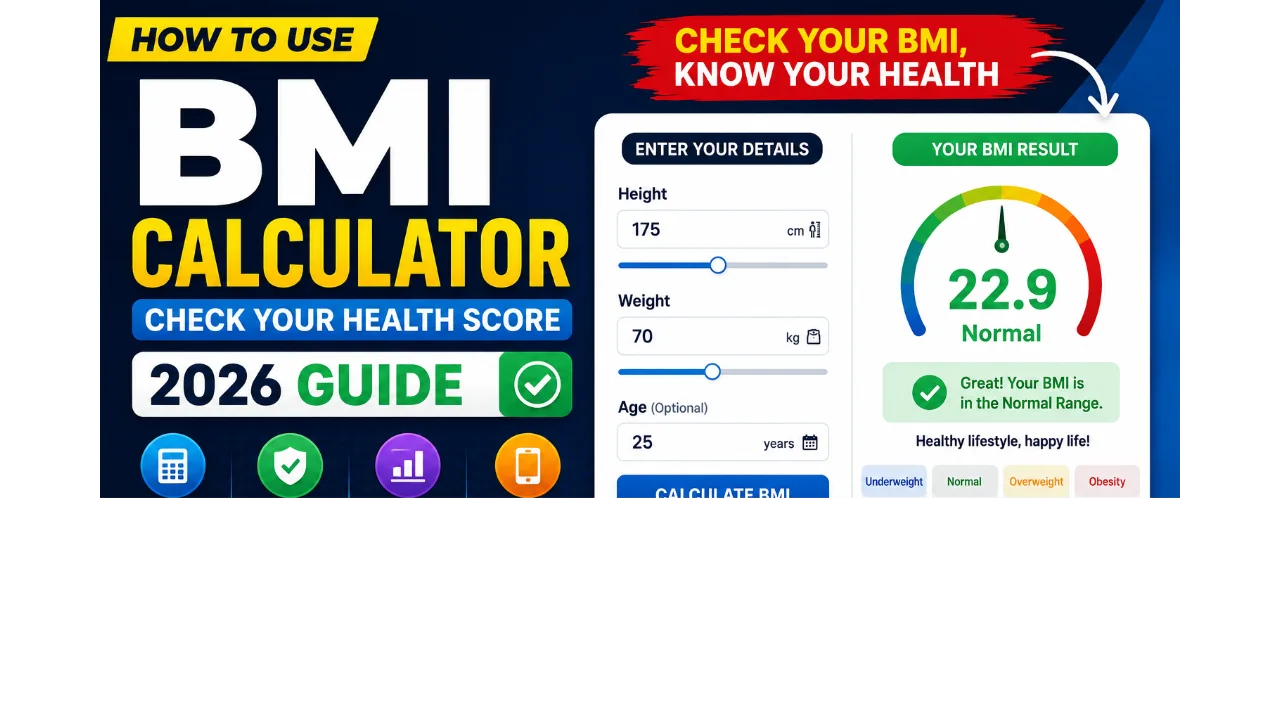
How to Calculate BMI: A Step-by-Step Guide (30 Seconds)
Have you ever wondered whether your current weight is actually healthy? Most people guess by looking in the mirror or checking the number on a weighing scale — but that approach never gives an accurate result. This is exactly the confusion a BMI Calculator clears up: a simple online tool that uses your height and weight to tell you whether you fall into the underweight, normal, overweight, or obese category. In this article, we'll cover everything about the BMI Calculator — what it is, how it works, how to use it, and why it should be the first and most important step in your health journey.
Whether you're serious about your fitness or simply curious whether your weight falls in the medically "normal" range, this guide is for you. We'll also walk through practical use cases, real-life examples, and clear up some common doubts people often have about BMI.
What is a BMI Calculator?
BMI stands for Body Mass Index. It's a mathematical formula that uses the ratio of your height and weight to tell you whether your body weight falls in a healthy range for your height.
A BMI Calculator is a digital tool that removes the need to do this calculation manually. You just enter your height and weight, and the tool gives you a result in seconds — no need to remember any complicated formula.
The standard formula is:
BMI = Weight (kg) ÷ [Height (m)]²
If you use imperial units (pounds and inches), the formula is slightly different, but a good BMI Calculator handles both unit systems automatically, so you don't have to convert anything manually.
The result comes out as a single number, which is then classified into health categories — underweight, normal weight, overweight, or obese. These categories are based on the standard guidelines from the World Health Organization (WHO), which are accepted globally.
Key Features of a Good BMI Calculator
Not every online BMI Calculator is the same quality. A reliable, user-friendly tool should have these features:
- Instant results — the calculation should happen right away, with no page reload or waiting time.
- Support for both Metric and Imperial units — both kg/cm and lbs/inches input options should be available, so every user can use it comfortably.
- Visual gauge or color-coded chart — just showing a number isn't enough; a visual representation makes the result easier to understand.
- Mobile-friendly design — most people browse from their phone these days, so the tool needs to run smoothly on mobile.
- Age and gender consideration — some advanced calculators include these factors for more personalized insight.
- No sign-up required — free and instant access, no need to create an account or share an email.
- Privacy-safe design — your data isn't stored anywhere; the calculation happens entirely inside your browser.
- Reference table — a table of standard BMI ranges so users can see exactly where they stand.
These features turn a simple calculator into a genuinely useful health companion that gives a reliable, fast result every time.
Benefits of Using a BMI Calculator
Using a BMI Calculator comes with quite a few practical, real-life benefits. Let's go through them in detail:
- Quick health awareness: You get an instant idea of your weight status without needing to visit a doctor or book an appointment. This is especially useful when you want a quick check on your health.
- Helps set fitness goals: If you're planning weight loss, weight gain, or muscle building, BMI gives you a clear starting baseline to measure your progress against.
- Early indication of health risks: Higher BMI categories are often associated with an increased risk of heart disease, type 2 diabetes, and joint-related problems. Early awareness lets you make timely lifestyle changes.
- Track progress over time: Checking your BMI at regular intervals lets you track your fitness journey long-term — weekly, monthly, or quarterly.
- Free and accessible anywhere: No gym membership fee or doctor consultation charge needed — this tool is completely free, available anytime, anywhere.
- Simple, stress-free process: No complicated steps — just enter height and weight and get a result instantly, with no confusion.
- Useful for family: You can easily check the BMI of your parents, siblings, or partner too, and guide them toward a healthier lifestyle.
- Preparation before a doctor visit: If you're about to consult a doctor about your health, already knowing your BMI can make the conversation more productive.
Step-by-Step Guide — How to Use a BMI Calculator
Using a BMI Calculator is very simple. Here's the complete step-by-step process:
- Open the tool — visit the website or page with the BMI Calculator.
- Select your unit — Metric (kg/cm) or Imperial (lbs/inches), whichever is convenient for you.
- Enter your height — entering accurate height is important so the result comes out correct.
- Enter your current weight — use your latest weighing scale reading for the best accuracy.
- Click the Calculate button — the result will be calculated instantly with one click.
- Analyze the result — your BMI number and its category (underweight, normal, overweight, obese) will show on screen.
- Check the reference table — to understand exactly where you stand compared to the standard ranges.
The entire process generally takes less than 30 seconds. No sign-up, no payment, and no technical knowledge required.
Real-Life Use Cases
A BMI Calculator isn't just for hardcore fitness enthusiasts — it has plenty of practical, everyday applications:
- Students and young adults: Knowing your BMI ahead of time is useful during school or college health checkups, especially when you need to provide fitness details for a health certificate or sports admission.
- Working professionals: With a busy schedule, a gym or doctor visit isn't always possible — this tool is a perfect solution for a quick self-check, even during an office break.
- New Year resolutions and fitness goals: For people setting weight loss or muscle gain goals, BMI gives a measurable, trackable starting point.
- Pregnancy planning: Doctors often include BMI as part of pre-pregnancy health assessments to support better overall health planning.
- Fitness trainers and gym coaches: This tool is handy for quickly recording a new client's baseline data, which helps in building a personalized workout plan.
- General health monitoring: For people who want to proactively track their health, a monthly or quarterly self-check can become a healthy habit.
- Senior citizens: Regular weight monitoring is important for older adults, and a BMI Calculator is a simple way to track their health status at a basic level.
BMI Calculator vs Other Similar Tools
Many people get confused about the difference between a BMI Calculator and other health-related tools. Here's a simple comparison table for clarity:
| Tool | What It Measures | Limitation |
|---|---|---|
| BMI Calculator | Ratio of height and weight | Doesn't directly account for muscle mass and fat distribution |
| Body Fat Calculator | Actual body fat percentage | Needs special equipment or skinfold readings for an accurate measurement |
| Calorie Calculator | Daily energy/calorie needs | Doesn't tell you a weight category or health status |
| Waist-to-Hip Ratio Calculator | Fat distribution pattern | Doesn't give a complete picture of overall weight |
The important point here is that BMI is a quick screening tool, not a diagnostic test. That means it gives a good starting point, but it isn't the final verdict on your health. Athletes or people with a muscular build can have a high BMI even though their actual body fat percentage is low. So BMI should always be viewed as one part of the overall health picture, not the sole and final indicator.
It's also worth understanding that every tool has its own place — no single tool can give you the complete health picture. The best approach is to use the BMI Calculator as a starting point, and if needed, also check other measurements like body fat percentage or waist-to-hip ratio. This gives you a more complete and balanced understanding of your health, rather than a judgment based on a single number.
How BMI Interpretation Shifts Across Life Stages
The same BMI number doesn't carry identical meaning at every age. Researchers and clinicians generally treat BMI as a moving target across a lifetime, not a fixed scale:
- Children and teens (2–19): BMI is plotted on age- and sex-specific percentile charts (BMI-for-age) rather than the fixed adult ranges, since body composition changes constantly during growth.
- Adults (20–64): The standard 18.5–24.9 "normal" range applies most directly to this group, which is who the WHO categories were originally built around.
- Older adults (65+): Some research suggests a slightly higher BMI (up to around 27) may be associated with better outcomes in this group, since muscle loss with age can make a "normal" BMI mask reduced muscle mass. This is debated among clinicians and isn't a universal guideline.
- Pregnant individuals: Standard BMI categories don't apply during pregnancy — weight gain is expected and tracked against pregnancy-specific targets instead.
This is part of why a single BMI number, calculated the same way for a 22-year-old and a 70-year-old, can mean fairly different things clinically — even though the math behind it never changes.
Understanding BMI Categories in Detail
BMI isn't just a number — it's classified into specific health categories, and each category carries its own significance. Let's understand them in a bit more detail:
- Underweight (BMI below 18.5): People in this category are often at risk of nutrition deficiency. A proper balanced diet, and a doctor's consultation if needed, is recommended.
- Normal Weight (BMI 18.5 - 24.9): This is considered the healthy range, where health risks are generally comparatively lower. Even within this range, it's important to maintain regular exercise and a balanced diet.
- Overweight (BMI 25 - 29.9): People in this category should gradually think about weight management to reduce future health risks. Small lifestyle changes, like a daily walk or better food choices, can make a big difference.
- Obese (BMI 30 or above): Health risks can be more significant in this category, such as heart disease, diabetes, and joint problems. Professional guidance from a doctor or nutritionist is highly recommended.
These categories are just a general guideline. Every individual's body type, genetics, and lifestyle are different, so talking to a healthcare professional for personalized advice remains the best approach.
The Asian BMI Standard — Why It's Different
There's an important point worth understanding here: the categories above are based on the international/Western standard. But research shows that many Asian populations can develop diabetes, heart disease, and other weight-related health risks at the same height-weight ratio more quickly — even when their BMI looks "normal" on the Western scale.
For this reason, the WHO Asia-Pacific guidelines recommend stricter BMI cutoffs for Asian populations:
| Category | Asian Standard | Standard (International) |
|---|---|---|
| Underweight | Below 18.5 | Below 18.5 |
| Normal Weight | 18.5 – 22.9 | 18.5 – 24.9 |
| Overweight | 23.0 – 24.9 | 25.0 – 29.9 |
| Obese | 25.0 or above | 30.0 or above |
In practical terms, this means: if your BMI is 24, you'd be "Normal" on the international chart, but you'd fall into the "Overweight" category under the Asian standard. If this applies to your background, it's worth giving more weight to the Asian standard when interpreting your result.
Frequently Asked Questions
1. How accurate is a BMI Calculator?
BMI gives a general estimate based only on height and weight. It doesn't directly measure muscle mass, bone density, or fat distribution, so it can be somewhat misleading for athletes or bodybuilders. For the general population, it remains a reliable and useful starting indicator.
2. Can a BMI Calculator be used for children too?
For children and teenagers, BMI calculation also factors in age and gender (known as BMI-for-age percentile), which differs from the standard adult BMI calculation. Using specific pediatric BMI charts is more accurate for children.
3. Does a healthy BMI range change as you get older?
Somewhat. The standard 18.5–24.9 range was built around working-age adults. For adults over 65, some research associates a slightly higher BMI with better health outcomes, since it can help offset age-related muscle loss — though this isn't a formal guideline and varies by individual health status.
3. What is considered a normal BMI range?
For the general adult population, a BMI between 18.5 and 24.9 falls in the normal weight category. Under the Asian standard, this range is slightly stricter — 18.5 to 22.9.
4. What should I do if my BMI comes out high or low?
If your BMI falls outside the normal range, it's a good signal to start paying attention to your diet and lifestyle. The best approach is to consult a doctor or certified nutritionist, especially if your BMI is significantly high or low.
5. Does a BMI Calculator give accurate results during pregnancy?
Body weight naturally increases during pregnancy for healthy reasons. So a regular BMI calculator doesn't give an accurate result for pregnant women. It's better to get specific, personalized guidance from a doctor instead.
6. How often should I use a BMI Calculator?
It depends on your goals. If you're on a weight loss or weight gain journey, checking weekly or bi-weekly is reasonable. For general health awareness, a monthly or quarterly check is also enough. There's no need to check daily, since weight naturally fluctuates throughout the day.
7. If my BMI is normal, does that mean I'm completely fit?
A normal BMI is a good sign, but it doesn't guarantee complete fitness. Fitness also includes factors like cardiovascular health, muscle strength, flexibility, and mental wellbeing. BMI only reflects your weight-to-height ratio, so a balanced diet, regular exercise, and adequate sleep are equally important for overall fitness.
Conclusion
A BMI Calculator is a simple, free, and effective tool that helps you take the first and most important step in your health journey. It isn't a diagnostic test, but it is a quick and reliable starting point that gives you a basic, clear idea of your weight status.
Whether you're setting fitness goals or simply want to be more aware of your health, the BMI Calculator is a useful, trustworthy companion that gives you a result in seconds, without any complicated process. Health is a long-term journey, and small, consistent steps lead to the most sustainable results. Checking your BMI regularly, maintaining a balanced diet, and adopting an active lifestyle — together, these help you become a healthier version of yourself.
If you found this article useful, share it with your friends and family so they can become more aware of their health too. And if you haven't checked your BMI yet, do it today — it only takes 30 seconds.
To continue your health journey, you can also check your daily calorie needs with our Calorie Calculator.

Very very workfull tool web